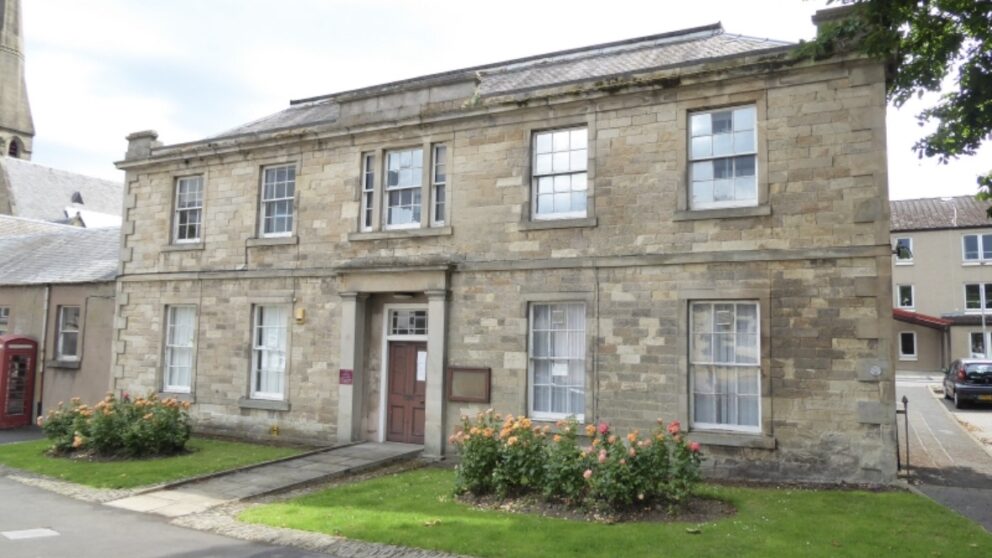
Plans to breathe new life into one of Selkirk’s historic buildings have been revealed, with proposals to transform the former Municipal Building into a thriving creative and community hub.
The Category B listed building, situated at Scott’s Place, has stood empty for many years, with its deteriorating condition becoming a growing concern among local residents.
Now, the Creative Coathanger group has launched an ambitious bid to restore the landmark building and bring it back into public use.
The building, which was once home to the father-in-law of famous Selkirk explorer Mungo Park and more recently served as a Contact Centre for Scottish Borders Council, could be transformed into a centre for artists, craftspeople and the wider community.
Under the proposals, the restored building would provide affordable studios, shared creative workspaces, workshops and exhibition areas, alongside community facilities and a café.
Detailed plans have already been prepared showing how the various rooms could be brought back into use.
The proposed ground floor would include a café, exhibition and event space, workshops, creative studios and a dedicated community area, while the upper floor would accommodate a number of individual studios.
It is hoped the project would not only safeguard an important part of Selkirk’s architectural heritage but also provide new opportunities for local artists, small businesses and community groups.
Creative Coathanger SCIO has already taken an important first step by funding a feasibility study to assess the building’s potential.
The next stage will involve exploring the possibility of a community asset transfer, which would see ownership of the building transferred from Scottish Borders Council.
The group would then face the challenge of securing the necessary funding to carry out the restoration, with financial support likely to be sought from a variety of sources.
Although the proposals remain at an early stage, the initiative offers fresh hope for a building which has remained unused for so long.
If successful, the project could see the historic Municipal Building once again become a busy and valued part of everyday life in Selkirk.
For many in the town, the prospect of restoring the prominent building rather than allowing it to deteriorate further will be a welcome development.